
How to Make Kimchi at Home, Following Extension Guidance
CanningLab is reader-supported. If you buy through our links we may earn a commission at no extra cost to you. As an Amazon Associate we earn from qualifying purchases. Disclosure.
Kimchi is a fermented vegetable like sauerkraut, but it's handled differently. Kraut sits on the counter for weeks; kimchi spends a day or two there and then goes into the fridge. NCHFP, the usual source for tested home-preserving recipes, doesn't publish a kimchi recipe. The guidance here comes from university Extension services, and we note where they disagree.
Why the fridge matters
UGA Extension's 2025 kimchi guide explains it: early in fermentation, the pH may not yet be low enough to stop certain pathogens, so getting kimchi into the refrigerator is essential for both flavor and safety. UGA says to keep it at 41°F or below. It also says that after about 2 weeks, fermentation brings kimchi below pH 4.6, acidic enough to inhibit most foodborne pathogens.
Containers
Colorado State says not to use metal containers or earthenware with cracks or chips, and to pick something that fits in your fridge. NC State says to fill the container only about two-thirds full, because fermentation releases carbon dioxide.
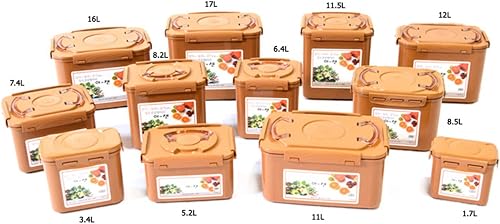
Kimchi containers are made for this. The 1.3-gallon one has an adjustable inner pressing plate plus an outer lid, and the 0.45-gallon one has an inner vacuum lid plus an outer lid, per the listings. Both are polypropylene and dishwasher safe; the 1.3-gallon one is also listed as BPA, DEHP and lead free.
Kimchi & Sauerkraut Fermentation Container, 1.3 gal
- 1.3 gallon (5.2 L) polypropylene container, per the listing
- Adjustable inner pressing plate plus outer lid
- BPA, DEHP and lead free; dishwasher, freezer and microwave safe
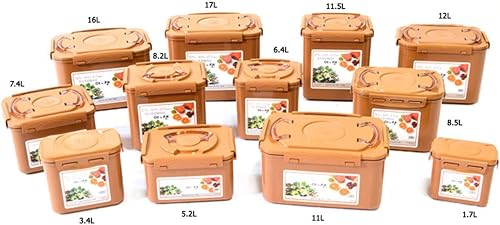
Kimchi & Sauerkraut Fermentation Container, 0.45 gal
- 0.45 gallon (1.7 L), per the listing
- Inner vacuum lid plus outer lid
- Polypropylene; dishwasher, freezer and microwave safe
For a bigger batch, a 1-gallon glass jar works. The FastRack jar comes with a grommeted lid and an airlock that lets gas escape, per the listing.
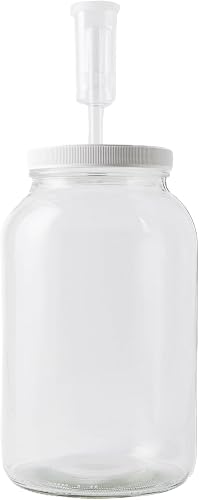
FastRack 1-Gallon Wide Mouth Jar with Airlock
- One 1-gallon wide mouth glass jar, per the listing
- BPA-free lid with built-in grommet
- Econolock airlock included to vent carbon dioxide
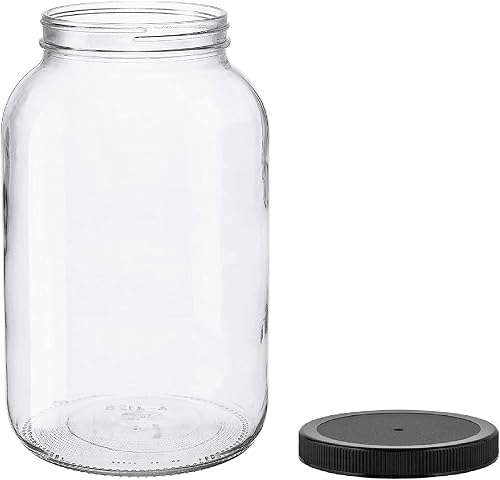
North Mountain Supply 1-Gallon Wide-Mouth Glass Jar
- 1-gallon wide-mouth glass jar with lid, per the listing
- Listed for fermenting, pickles and dry storage
- Made in the USA, per the listing
Step by step
This follows the method shared by Colorado State and NC State Extension. Oregon State's small recipe is below if you want to start with about 3 cups.
- Clean up. UGA says to wash your hands for at least 20 seconds and sanitize equipment by washing it, then submerging it in water of at least 160°F for at least 30 seconds.
- Brine dip. Dissolve 1/2 cup of coarse, non-iodized salt in 1 gallon of water and dip the cut cabbage in it.
- Salt. Massage 1 cup of salt into 2 heads (6 to 8 pounds) of napa cabbage. Cover and let it sit at room temperature for 3 to 6 hours. UGA's version rubs the cabbage with salt and massages it every 30 minutes for 2 hours.
- Rinse and drain. NC State says to rinse 3 to 4 times in cold water and drain for at least 30 minutes.
- Season and pack. Mix in the seasoning paste from your recipe (Colorado State's and NC State's pages include one) and pack tightly to cut down on air pockets. Fill only about two-thirds of the container.
- Ferment briefly. NC State says about 68°F is ideal: ferment only 1 to 2 days at room temperature, tasting daily. Or put it straight into the fridge, where it ferments slowly over 3 to 4 days.
- Refrigerate. Cover tightly and store in the fridge.
Small batch (Oregon State)
Oregon State's recipe makes about 3 cups from 2 pounds of napa cabbage and 2-1/2 tablespoons of salt. Toss the cabbage with 2 tablespoons of the salt and let it sit several hours, until it's down to about half its volume. Rinse, drain and pack loosely into a 1-quart jar. Leave it at room temperature for 1 to 4 days, then refrigerate. Note that this is longer than the 1 to 2 days Colorado State and NC State give, and UW-Madison limits its recipe to under 12 hours at room temperature. When in doubt, use the shorter time.
Salt
Oregon State and Colorado State say kimchi's final salt concentration runs 2 to 5%. UGA says to stick with the salt level in a validated recipe rather than cutting it. Canning and pickling salt is non-iodized; see our salt guide.
How long it keeps: plan on 1 week
Use the shortest figure: 1 week in the fridge. It's been known to last longer, as the other sources below show.
| Source | What it says about refrigerated kimchi |
|---|---|
| Oregon State / Colorado State | Store refrigerated; best eaten within 1 week, since quality deteriorates with longer fermentation |
| UW-Madison Extension | Should be safe up to 2 weeks in the fridge for its (not research-tested) recipe, if room-temperature time stays under 12 hours |
| Oregon State Ask an Expert | Keeps in the fridge for months and keeps fermenting (a Master Food Preserver's answer) |
Colorado State and Oregon State frame 1 week as a quality limit. UW-Madison's 2 weeks is a safety condition for its recipe, and it applies only if room-temperature time stays under 12 hours. Whatever the age, look before you eat.
Can you can kimchi?
No. UW-Madison Extension (Winnebago County) says the kimchi recipe it shares “can not be safely canned,” and NCHFP has no tested canning process for kimchi. If you want shelf-stable fermented cabbage, sauerkraut has a tested canning process.
FAQ
How long should kimchi sit out?
1 to 2 days at room temperature, then the fridge.
Can you can kimchi?
Not with any tested process. UW-Madison Extension says its recipe can't be safely canned.
How long does it last in the fridge?
Plan on 1 week, per Colorado State and Oregon State. It's been known to last longer (UW-Madison gives up to 2 weeks for its recipe). Discard it if it molds or turns slimy.
Does NCHFP have a kimchi recipe?
No. This page uses university Extension sources.